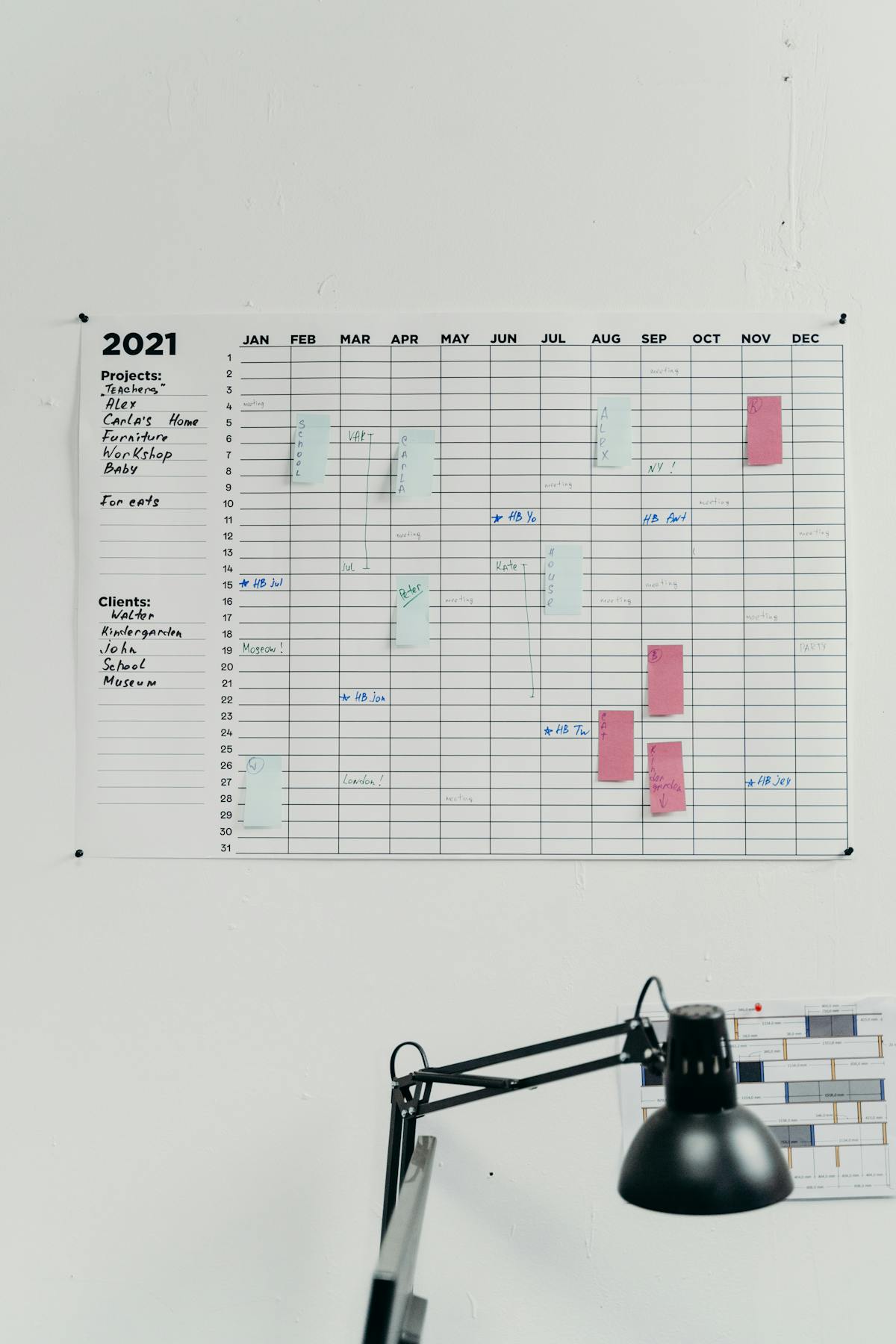
The average knowledge worker switches tasks every 3 minutes and takes 23 minutes to fully return to the interrupted task. But task-switching isn’t only triggered by interruptions, it’s triggered by moving between fundamentally different types of work within the same day.
Writing client proposals requires a different cognitive mode than doing client deliverables. Doing deliverables requires a different mode than sales calls. Sales calls require a different mode than accounting. When you mix all four modes in a single day, a client deliverable in the morning, a sales call at noon, proposal writing at 2pm, admin at 4pm, you’re imposing four context switches and paying the entry cost for each.
Themed days are the structural fix. Instead of running four cognitive modes per day, you run one. The switching overhead drops to near zero, and the depth of work in each mode increases dramatically.
The 5-Theme Template
This structure is the baseline. Adapt it to your specific business after running it for 30 days.
Monday: Business Development Outbound outreach, proposal writing, follow-ups with prospects, content marketing, networking, case study writing, testimonial requests. The core activity: anything that brings in future revenue. Monday morning is the week’s highest-energy business development window, use it before it fills with reactive work.
Tuesday: Client Delivery Deep execution on active client projects. No calls. No new business. Just delivery. This is the longest uninterrupted work block of the week because client work is the core value driver of the business.
Wednesday: Client Delivery Same as Tuesday. Back-to-back delivery days mean you can get into a project rhythm over 2 days instead of picking it up and putting it down across the week.
Thursday: Calls and Meetings All client calls, prospect calls, check-ins, collaborations, and any communication that requires real-time interaction. Calendly configured to show Thursday availability only (11am–5pm). Batching all calls into one day means you only do the mental preparation for calls once per week, not five times.
Friday: Admin and Planning Invoicing, contracts, filing, tool maintenance, weekly review, OKR check-in, next week’s calendar setup. This is also when you schedule any work that didn’t get done during the week, and where you flag anything that needs to move into Monday’s business development queue.
The Calendar Setup That Enforces It
The theme only holds if your calendar enforces it. Here’s the setup:
Calendly (or equivalent) Create a single meeting type: “30-minute call.” Set availability to Thursdays, 11am–5pm only. No exceptions in the tool. If someone needs a Monday call, they’ll see the next available Thursday. Most will book it.
Google Calendar / Outlook Create recurring events for each day’s theme. Block Monday 9am–5pm as “BD Day” (mark as busy). Block Tuesday and Wednesday 9am–1pm as “Delivery Block” (mark as busy). Friday 3pm–5pm as “Weekly Review” (mark as busy).
These blocks aren’t fake, they’re real commitments. When someone tries to schedule something that conflicts, you have a visible calendar block to point to.
The one exception to configure: if you have an existing client with a standing weekly call, move it to Thursday. Most clients accept this when you explain that you’re restructuring your schedule to improve deliverable quality (which is true, batching their call with other calls makes your Thursday more efficient, not worse for them).
Protection Rituals for Each Day
Themes erode without protection rituals, the habits that reinforce the day’s mode and push back against intrusions.
Monday Morning Ritual (BD Day) Start by reviewing your pipeline, what deals are active, what follow-up is due. Write your one BD goal for the day before opening email. Do not schedule any calls before noon on Monday. The morning is your highest-energy BD window.
Tuesday/Wednesday Morning Ritual (Delivery Days) Before opening anything, write the single client deliverable you’re committing to complete by end of day. Open your project files first, not your inbox. Delivery days start in the work, not in communication.
Thursday Morning Ritual (Call Day) Review your call agenda for the day. Block 15 minutes before each call for prep (review previous notes, confirm agenda, know your desired outcome). Block 10 minutes after each call for notes and follow-up actions. Calls without prep and follow-up are lost calls.
Friday Morning Ritual (Admin Day) Start with invoicing, any unbilled work from the week gets invoiced before anything else. Money first, admin second. Then move through the weekly review template.
The Trade-Offs to Accept Before Starting
Themed days have real costs. Pretending they don’t will cause you to abandon the system at the first friction point.
Trade-off 1: You’re less responsive to ad-hoc client requests. A client who emails Monday asking for a call Tuesday will need to wait until Thursday. Your response: “I have call availability on Thursdays, would [time] work for you?” Some clients will find this inflexible. Most won’t. And the ones who genuinely need real-time availability are surfacing a working relationship that was already problematic.
Trade-off 2: Genuine emergencies don’t respect themes. They don’t. When a client deliverable is on fire on a Monday, you handle it. The theme is a default, not a cage. The discipline is in recovering the structure after the emergency, not in letting the exception become the rule.
Trade-off 3: You need to batch up work in advance. If a proposal needs to go out Thursday and Thursday is calls day, you’re writing it Monday. This requires more planning discipline than the ad-hoc “I’ll write it when it’s due” approach. The payoff is that your delivery work is never interrupted by proposal writing because proposal writing has its own day.
Every time you switch between business development and client delivery in the same day, you’re paying a mental setup cost twice. Themed days mean you pay it once. Over a week, you recover 2–3 hours of effective working time without adding a single hour to your schedule.
The Client Communication Script
You don’t need to explain your entire scheduling philosophy to clients. You need one short script for each common situation:
When a client asks for a Monday call: “My call availability is Thursdays, I keep Mon–Wed focused for project delivery. Does Thursday at [time] work for you?”
When a client needs an urgent mid-week check-in: “I have some availability Thursday afternoon, I can fit in 20 minutes at 2 or 3pm. Does either work? If something needs immediate attention before then, send it over in writing and I’ll prioritize it.”
When explaining your schedule proactively (onboarding a new client): “To give you the best work, I block Mon–Wed for focused project delivery and reserve Thursdays for client calls. You’ll always get same-day email responses, and we can meet Thursday. This is how I make sure your project gets full attention rather than being interrupted by coordination work.”
No apology. No lengthy explanation. Just the facts, framed around benefit to the client.
The 30-Day Test
Run the full themed-day structure for 30 days before evaluating it. The first 2 weeks will feel rigid, you’ll notice every time a situation doesn’t fit cleanly into a theme. This is normal. The rigidity is the point: the structure is training your habits and resetting client expectations simultaneously.
After 30 days, track:
- Did you complete your key deliverable on delivery days 80%+ of the time?
- Did you run at least 2 hours of BD on Monday most weeks?
- Is your Thursday call schedule efficiently packed or still scattered?
Adjust the theme assignments based on what you find. If your business is 80% delivery, consider three delivery days (Tuesday–Thursday) and move calls to Friday morning. The template is a starting point. The principle, one cognitive mode per day, is non-negotiable.
The goal of themed days isn’t perfect schedule adherence. It’s building a default structure strong enough that exceptions stand out. When every day is a mix of everything, exceptions are invisible. When each day has a clear purpose, a mismatch is obvious and fixable.
The Compound Effect After 90 Days
By the end of a quarter on themed days, you’ll notice something that’s hard to predict in advance: your business development becomes more consistent. Before themed days, BD work got squeezed by urgent delivery and admin. With a protected Monday, it happens every week regardless of project load.
Consistent weekly BD, even just 3–4 hours of Monday outreach, produces a materially different pipeline within 90 days. The freelancers who have feast-famine cycles are almost uniformly the ones who do BD only when they’re slow, which means they’re always either overloaded or hunting. A dedicated Monday prevents both extremes.
That’s the long-term case for themed days. Not productivity as an abstraction, but a business that has consistent work, consistent revenue, and consistent time to deliver quality.
Ready to send stronger proposals?
Build, send, and track proposals in one place so follow-up is easier.
Start your free trial →