You did not choose your current rate through research. You chose it the first time a prospect asked, you felt the pull of rejection, and you named something low enough to feel safe. Then you kept charging it. That is how most freelance pricing decisions get made, not through analysis, but through a single anxious moment that calcified into policy. The Pricing Honesty Audit exists to unwind that moment and replace it with a number built on actual costs, real market data, and a defensible logic you can walk a prospect through.
Why Fear Compresses Pricing Before the Conversation Starts
The fear that drives underpricing is not fear of poverty, it is fear of rejection. Specifically, the fear that naming a high number will cause a prospect to leave, to judge you as overconfident, or to reveal that your work is not as valuable as you hoped. This is an anticipatory fear, and it operates before any prospect interaction. It lives in the moment between “what should I charge?” and “what do I say?”
Research on loss aversion, documented extensively in Daniel Kahneman’s work on behavioral economics, shows that the psychological weight of a potential loss is roughly twice the weight of an equivalent gain. When you underprice by $500, you are trading $500 in revenue for relief from the anticipated pain of a prospect’s negative reaction. That is the mechanism. Understanding it does not make it disappear, but it makes it legible, and legible fears can be examined.
The 7-Question Pricing Honesty Audit
Work through each question honestly. Record your answers before reading ahead.
Question 1: When did you last raise your rate? If the answer is “over a year ago” or “never for new clients,” you are almost certainly underpriced relative to your current skill level and market rates.
Question 2: What happens in your body when you state your rate? Anxiety, rushing through the number, immediate disclaimers, these are fear signals. Calm delivery is the baseline. Anything below baseline is fear.
Question 3: Have you accepted a project knowing you undercharged? Yes is a fee-based fear signal. “Yes, but I needed the money” is a cash-flow problem that has been resolved by underpricing rather than pipeline development.
Question 4: What is your current hourly effective rate? Divide last month’s revenue by total hours worked, including admin, proposals, and unpaid revisions. If the number surprises you, your rates are not covering your full cost of delivery.
Question 5: Do you discount before being asked? Pre-emptive discounting is fear made visible. The prospect has not objected; you objected on their behalf.
Question 6: What do your three best clients pay? If your best clients, the ones who value you, refer you, and never argue about scope, are paying the same as your worst clients, your pricing is not client-differentiated. That is a structural problem, not a market one.
Question 7: What would you charge if you knew the prospect would say yes? The gap between your current rate and your answer to this question is your fear discount.
The gap between your current rate and the number you’d charge if you knew they’d say yes, that gap is your fear discount. Closing it is the entire job.
Interpreting Your Audit Results
Score your answers on two dimensions: frequency of fear signals, and magnitude of the fear discount revealed in Question 7.
1–2 fear signals, small discount gap (under 15%): Your pricing is reasonable. You may have specific service lines that are underpriced, but the overall structure is calibrated. Focus on testing rate increases for new service lines rather than a wholesale raise.
3–4 fear signals, moderate discount gap (15–30%): You are in the zone where most freelancers live. The underpricing is significant enough to affect annual income materially but not so severe that it signals a fundamental confidence problem. The 4-step rebuild below is designed for this range.
5–7 fear signals, large discount gap (30%+): The underpricing is substantial and likely connected to a belief about your own value that needs direct examination, not just a rate recalculation. Consider peer coaching or a pricing mastermind alongside the rebuild process.
The 4-Step Rate Rebuild Process

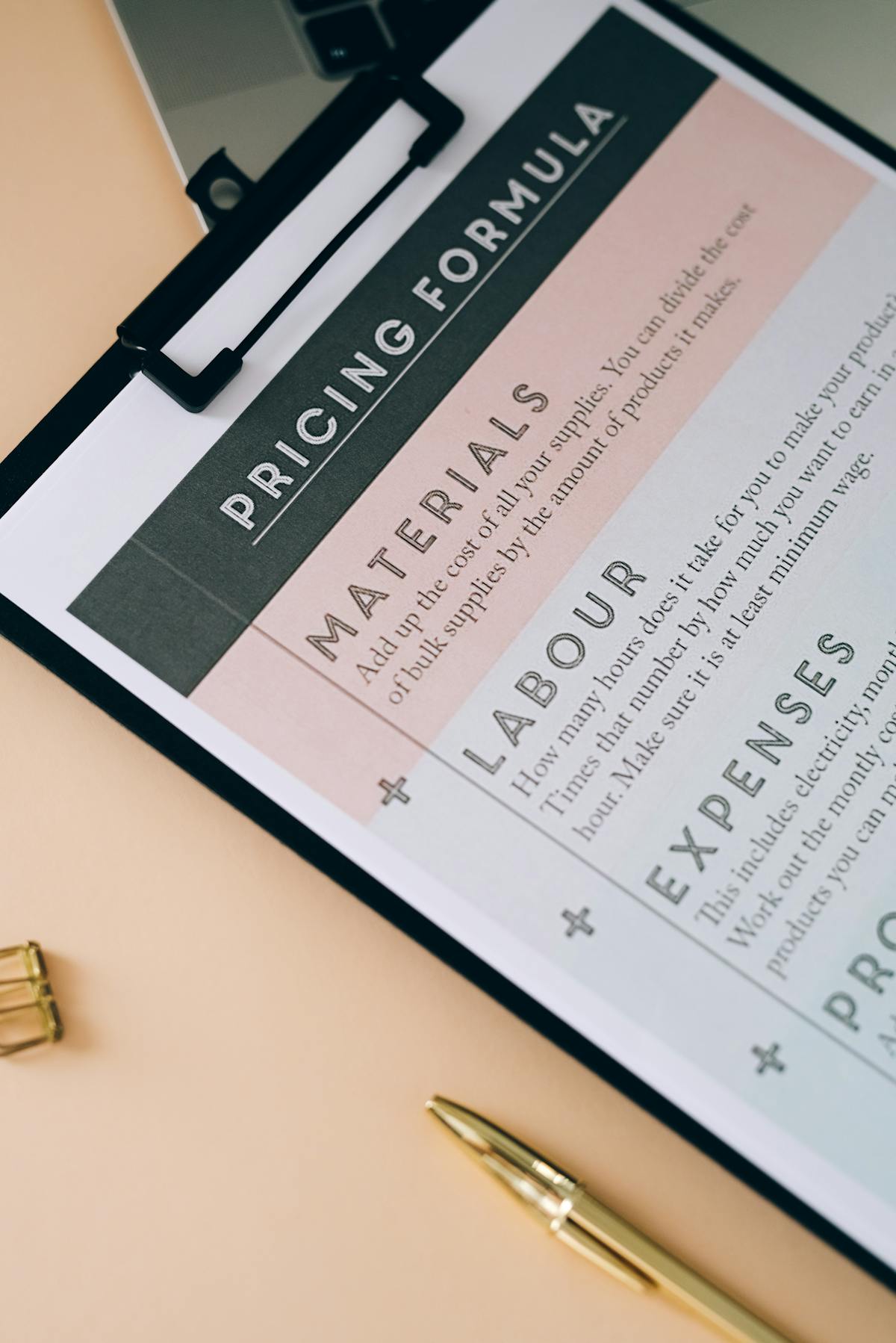
Step 1: Calculate your true floor. Add your monthly fixed costs (software, taxes, insurance, equipment amortization) to your personal living costs. Divide by your billable hours per month. This is your absolute minimum, the number below which you are subsidizing your clients’ projects with your own money.
Step 2: Research the comp set. Identify three to five peers with equivalent skills and similar positioning. Ask directly, many freelancers share rates in trusted communities, or use rate surveys from professional associations. Build a range, not a single number.
Step 3: Apply the value multiplier. Your floor is a cost-recovery number. Your market rate is a value number. The multiplier is the premium your expertise, speed, and results command above a commodity provider. A clear niche, a portfolio of measurable outcomes, and a defined process each add 10–20% to your defensible rate above the comp set midpoint.
Step 4: Test before you commit. Name the new rate in a discovery call before you formalize it in a proposal. The prospect’s reaction is data. Pushback is normal and manageable. Acceptance is confirmation. A rate you have never said out loud is a rate you have never truly owned.
Defending the Number Without Apologizing for It
The delivery of a price matters as much as the price itself. Three delivery rules:
State the number once, clearly, then stop talking. Silence after the price is professional. Filling that silence with justifications signals that you do not believe the number yourself.
Reframe any pushback as a scope conversation, not a price negotiation. “That budget would cover [smaller scope]. To achieve [the full outcome], the investment is $X. Which scope are we solving for?” This keeps the conversation on value, not cost.
Do not anchor the prospect to a lower number by mentioning what you “used to charge.” Your history is not relevant to the current engagement’s value.
State the number once, stop talking, and let the silence sit. Every word you add after the price is a signal that you don’t believe it.
The Long-Term Cost of Staying Underpriced
Underpricing by 30% over three years of freelancing at $120,000 target annual revenue costs $108,000 in lost income. It also costs the intangible: the resentment that builds when you are working hard for a number that does not feel worth the effort, the clients it attracts who expect low prices and low commitment in return, and the positioning signal it sends, that your work is a commodity rather than a specialist service.
The Pricing Honesty Audit is not about aggression. It is about alignment between what you charge and what your work is worth. That alignment is the foundation every profitable freelance business is built on.